
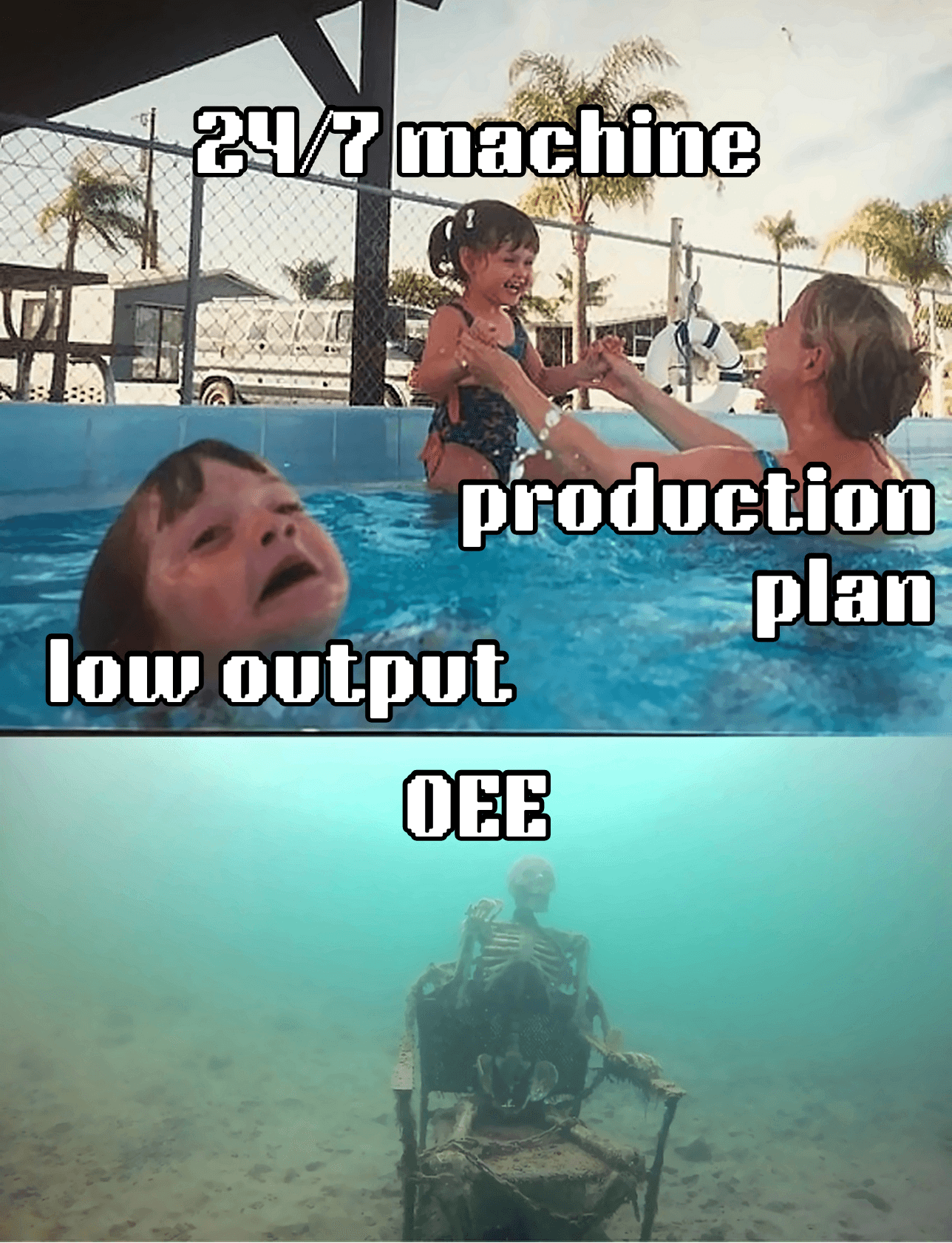
Why "Always Running" Doesn't Mean High Output
The benchmark for world-class manufacturing is approximately 85% Overall Equipment Effectiveness (OEE), with top-performing operations occasionally reaching 90% or higher.
Yet when manufacturers begin measuring OEE for the first time, they often discover performance far below expectations. Many plants operate in the 40–65% range, meaning a machine that appears to run around the clock is actually idle, slowed, or otherwise underperforming for a significant portion of the available time.
The challenge is that much of this lost production never appears in a downtime report. It leaks away through dozens of small interruptions that individually seem too minor to matter. For example:
- The chip conveyor fills and pauses production for four minutes
- A probing routine retries a measurement
- An operator adjusts an offset and waits to verify the result
- A minor alarm clears itself after a few seconds but halts the cycle
None of these events are significant on their own, and most never get logged anywhere. Yet on a machine expected to run continuously, they occur dozens of times per shift and can collectively consume hours of productive capacity every week.
The losses are not limited to downtime. Some of the most costly productivity drains occur while the machine is technically still running.
An operator reduces the feed rate override to 70% during a difficult cut and forgets to restore it. The machine completes every cycle without generating a single alarm, but over each eight-hour shift it quietly gives up more than two hours of productive capacity.
Cycle times can drift in the same way. Tools wear. Programs accumulate conservative edits. Speeds and feeds are adjusted to solve one-off problems and never revisited. A job originally quoted at four minutes and ten seconds gradually stretches to four minutes and forty-five seconds. Parts are still being produced, so no one notices. Yet over weeks and months, hundreds of parts that should have been made never are, and the schedule built around the original cycle time becomes increasingly inaccurate.
The hardest part about diagnosing a low-output machine is that nothing appears obviously wrong. An experienced machinist, engineer, or operations manager standing beside the machine all day would likely spot the problem. Most shops simply don't have the time or resources to dedicate someone to that task.
What Getting That Time Back Is Worth
When a machine goes down completely, the cost is obvious because production stops. Recovering hidden utilization is different. The machine is already running, the labor is already scheduled, and the fixed costs have already been incurred. Every additional part "recovered" is from capacity the shop already paid for. In many cases, that extra output comes with very little additional cost, making it some of the highest-margin production available.
The numbers are hard to ignore. One tier-one supplier to a top-three automaker improved throughput on a continuously running line by more than 24%, not by adding headcount or buying another machine, but by finding the small losses that were quietly dragging production down.
On a machine running three shifts, recovering just two hours of productive time per day creates nearly an additional shift of output every week without adding costs for equipment, floor space, or labor.
Seeing What the Machine Is Actually Doing
Real-time machine monitoring helps close the gap between what the production plan says a machine is doing and what it is actually doing.
Systems such as Sense continuously track machine states to determine whether a machine is actively cutting, idling between cycles, sitting in an alarm condition, or running at a reduced feed rate. Short interruptions that would never appear in an operator's downtime report become visible when accumulated across an entire shift. Cycle time drift becomes apparent before months of lost production have accumulated.
Perhaps most importantly, machine monitoring creates a common source of truth. If one shift consistently produces fewer parts than another, the data reveals the pattern before it turns into finger-pointing or speculation.
For one mid-sized, Pennsylvania-based shop, this was especially true. The team considered a particular machine to be a reliable, consistently productive asset. It was "always running" in their minds. However, once Sense was installed, a pattern of short pauses throughout the day became visible. Individually, any single interruption seemed insignificant, but together, they represented nearly two hours of recoverable machine time every day.
“Sense helped solve a low output machine that was "always running" by identifying numerous short pauses throughout the day and allowed for recovery of ~2 hours of machine time per day.”
— Operations Manager, Pennsylvania Machine Shop
Your machine that is "always running" is not necessarily always producing. The only way to know the difference is to measure what the machine is actually doing, not just whether it is powered on.
Sense in your shop, risk-free.
See if you qualify for 100% money-back guarantee on your first order.